They stand beside you in public. They provide. They say the right things when others are watching. But behind closed doors, they keep reminding you of your mistakes, your weaknesses, your past, and your dependency. Slowly, quietly, something inside you starts shrinking.
I have watched this happen to people around me for years, in Pakistan and beyond. In many Pakistani households, a woman’s emotional pain is often dismissed if the man is fulfilling visible responsibilities. If he provides, pays bills, or maintains the public image of the family, people may ignore what happens inside the woman’s mind.
This is why hidden emotional toxicity becomes so difficult to explain. The damage has no bruise, no receipt, and no easy proof, but it still changes the person from inside. The pattern is almost always the same.
From the outside, everything looks fine. From the inside, the person is exhausted, confused, and slowly losing the version of themselves they used to like
This article is about that specific kind of pain. The emotional toxicity that hides inside relationships which look supportive. And more importantly, it is about the way out.
The Kind of Toxicity Nobody Warns You About
When we hear the word toxic, we imagine shouting, insults, or obvious cruelty. But the most damaging toxicity I have seen rarely looks like that.
It looks like taunts wrapped in jokes. It looks like someone bringing up your old mistake in every disagreement, years after it happened. It looks like sarcasm about your weak moments, comparison with others, silent punishment when you show independence, and a strange discomfort whenever you start to grow.
The confusing part is that the same person may also be generous. They may provide for you, help you, and defend you publicly. So your mind keeps asking a painful question. Should I be grateful, or should I be hurt?
Here is the answer that took me a long time to accept. Both things can be true at once. Someone can support you materially and damage you emotionally. Provision is not the same as protection. Comfort is not the same as kindness. A house can be full of facilities and still feel emotionally unsafe.
Why This Pattern Is So Hard to See
This article is not a diagnosis of any person or relationship. It is a reflective guide for people who feel emotionally diminished in relationships that appear normal from the outside.
If your situation involves fear, threats, physical harm, forced isolation, or severe control, please treat it as a safety concern and seek trusted support.
Emotional toxicity survives on confusion. If the harm were obvious and consistent, you might recognise it and respond more clearly. But when hurtful behavior mixes with affection, generosity, or calm periods, you may start to doubt your judgment.
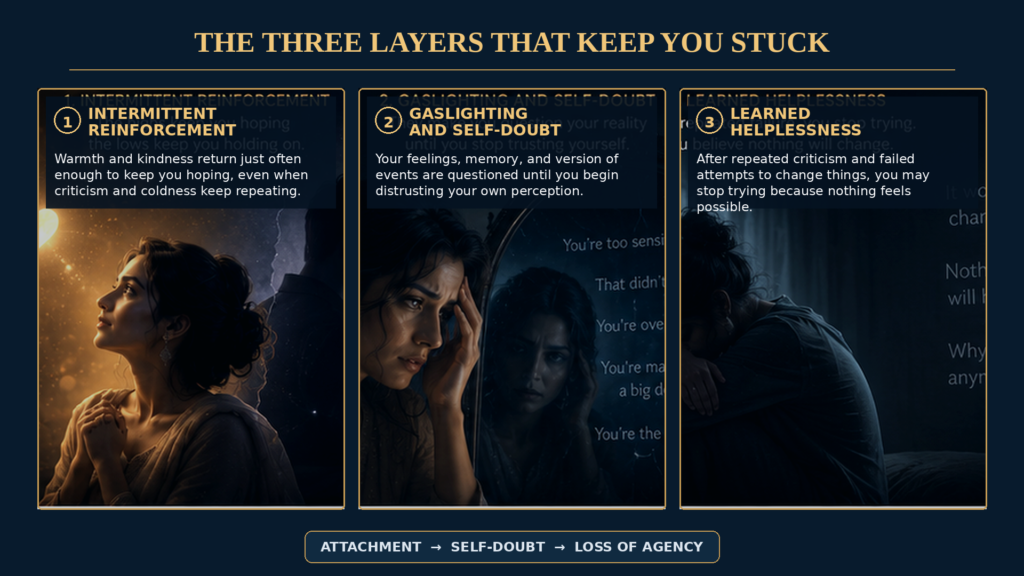
Three psychological patterns can make this kind of relationship especially difficult to understand and change.
The First Layer: Intermittent Reinforcement
Psychology gives us useful language for understanding this pattern. When kindness and cruelty arrive unpredictably from the same person, the nervous system can become attached to the hope of the ‘good version’ returning.
This is the first layer called intermittent reinforcement, unpredictable alternation between warmth and emotional harm. This is the same mechanism that makes gambling addictive.
The same person may be kind, generous, and supportive on some days, then cold, critical, or humiliating on others. Because the positive moments keep returning occasionally, you continue hoping that the caring version of the person will become permanent. This is one reason people often stay emotionally invested even when the relationship keeps hurting them.
The Second Layer: Gaslighting and Self-Doubt
The second layer begins when the person repeatedly questions your memory, feelings, or interpretation of events. This pattern is commonly described as gaslighting. The deepest damage is not limited to one disagreement. It happens when you gradually hand over your authority to understand your own experiences.
Dr. Robin Stern, a psychologist at Yale, wrote an entire book on this pattern called The Gaslight Effect. Her research on gaslighting shows that the real damage is not the argument itself. It is the way you gradually hand over the authority to define reality to someone else.
They may tell you that you are too sensitive, that you misunderstood them, that the incident never happened as you remember it, or that you are creating unnecessary problems. Over time, you may stop trusting your own perception and begin relying on the other person to tell you what is real.
The Third Layer: Learned Helplessness
In our part of the world, and honestly in most parts of the world, there is a sentence that keeps people trapped for decades.
At least they provide for you. What else do you want?
This sentence sounds wise. It is actually a trap. It teaches people that emotional respect is a luxury, that peace of mind is greed, and that wanting encouragement makes you ungrateful. So people learn to swallow the taunts, smile at family gatherings, and cry privately.
But respect is not a luxury. Psychological safety is not greed. Human beings need dignity the way they need food. A relationship where your past is used as a weapon is not generous, no matter how much it provides.
Gratitude is a beautiful quality. Using gratitude to silence pain is not.
What Rising Above Does Not Mean
Rising above does not mean tolerating everything silently. It does not mean pretending the pain is spiritual maturity. It does not mean proving your worth to someone committed to misunderstanding you. And it does not mean becoming cruel in return.
Rising above means choosing clarity over confusion, growth over emotional dependency, and self-respect over endless explanation.
Seven Quiet Moves to Rise Above It
Now the part that matters most. The way out is not bitterness, and it is not a dramatic explosion. In most social environments, especially conservative ones, loud rebellion gets punished while the original toxicity gets excused. The smarter path is quiet, internal, and strategic.
1. Name the pattern honestly
Stop calling it mood, nature, or stress. When someone repeatedly uses your mistakes, weaknesses, or dependency to control your emotions, name it for what it is. You do not need to announce this to anyone. You only need to stop lying to yourself about it. Clarity is the first act of strength, and it happens silently, inside your own mind.
2. Stop seeking emotional permission
Some people will only support the version of you that stays small and manageable.
The moment you start learning, earning, healing, or growing confident, they become uncomfortable.
Understand this clearly. Their discomfort is not proof that you are wrong. Stop waiting for approval from someone who benefits from your weakness. It is never coming, and you do not need it.
3. Separate your identity from their taunts
You are not your past mistake. You are not your weakest moment. You are not the story someone repeats to keep you small. A person who constantly drags you back to your past is usually trying to keep you emotionally trapped there, because a person stuck in yesterday is easier to control today.
Your history is a chapter. It was never meant to be your name.
4. Build quiet strength
This is where real change begins. Instead of arguing about your worth, start building it. Learn a skill. Improve your health. Read. Earn something of your own, even if it starts small. Strengthen your faith if faith matters to you. None of this requires anyone’s permission, and most of it can be done without announcement.
Power built in silence cannot be taunted out of you.
Not everyone has the freedom to leave, confront, or make sudden decisions. Some people have children, financial dependency, family pressure, social fear, or no safe support system. So rising above does not always begin with a dramatic external change.
Sometimes it starts with private emotional recovery. Keep your mind clear. Build skills quietly. Save small resources. Document serious incidents if needed. Reconnect with people who remind you of your worth.
5. Set calm boundaries
A boundary is not always a fight. Sometimes it is one calm sentence.
For example, a calm boundary can sound like this:
‘I am willing to discuss the issue, but not through taunts.’
‘My past mistake is not a weapon for every argument.’
‘I will continue this conversation when the tone is respectful.’
‘I understand your concern, but I will not accept humiliation.’
‘I am not refusing accountability. I am refusing repeated emotional punishment.’
These sentences are not meant to start a fight. They are meant to protect your dignity without losing control of your tone. You stop over-explaining.
Dr. Henry Cloud, who has written extensively on this subject in his book Boundaries, makes a point I have never forgotten.
A boundary is not about controlling the other person. It is about deciding what you will and will not participate in.
6. Expand your world
Toxic dynamics grow strongest when one person’s approval is your entire emotional world. So deliberately make your world bigger. Friendships, learning, work, community, spiritual life, health routines.
Psychologist Kristin Neff’s research on self-compassion shows that treating yourself with the same kindness you would offer a friend is not self-pity. It is one of the strongest predictors of emotional resilience. The larger your inner and outer world becomes, the less one person’s bitterness can define your future.
7. Know when it is bigger than mindset
Everything above applies to emotional toxicity. But if there is fear, threats, physical harm, forced isolation, or complete financial control, this is no longer a mindset problem. It is a safety issue.
Please involve a trusted family member, a counsellor, or a professional support service. Reaching out is not weakness or betrayal. It is wisdom. Organizations and therapists exist for exactly these situations, and using them is a sign of strength.
The Strongest Reply Is Altitude
There is a line I keep returning to whenever I think about this subject.
You do not have to fight everyone who wants you small. Sometimes the strongest reply is to rise so high that their toxicity can no longer reach your peace.
Rising above does not mean pretending the pain does not exist. It means refusing to build your identity inside it. It means becoming so rooted in your own growth, your own values, and your own quiet progress that the taunts start landing on someone who no longer lives at that address.
A person does not become strong because life was easy on them. They become strong when they finally stop shrinking to make toxic people comfortable.
That decision is available to you today. Quietly. Starting now.
FAQ
Can someone be toxic even if they are generous and providing?
Yes. Material support and emotional harm can exist in the same person. Generosity does not cancel taunts, control, or repeated attacks on your confidence. Both realities should be acknowledged honestly rather than using one to deny the other.
How do I know if I am overreacting or actually experiencing emotional toxicity?
Look for patterns, not single incidents. Everyone has bad days. But if someone repeatedly brings up your past mistakes, mocks your weaknesses, punishes your growth, and leaves you feeling smaller after most interactions, that is a pattern worth taking seriously.
Is it wrong to set boundaries with family members?
No. Boundaries are not disrespect. A calm boundary protects the relationship from further damage by stopping the behavior that poisons it. You can hold a boundary with softness and still hold it firmly.
What if I cannot leave the situation right now?
Many people cannot immediately change their circumstances, and that is okay. Focus on what is in your control. Build skills, protect your inner identity, expand your support system, and reduce emotional dependence on the toxic person. Quiet strength today creates options tomorrow.
When should I seek professional help?
If the situation involves fear, threats, physical harm, isolation, or financial control, or if your mental health is seriously suffering, speak to a counsellor, therapist, or trusted support service. Professional help is a practical tool, not a last resort.